|
Yuxiang Fu
I am a PhD student in the ECE department at UBC, and a member in DSL lab, Prof. Renjie Liao. My PhD is supported by the Four Year Doctoral Fellowship (4YF). I am very lucky to collaborate with Prof. Lele Wang and Prof Ke Li. Previously, I received an Honours degree in CS from UBC under the supervision of Prof. Andrew Roth. During my undergraduate studies, I am fortunate to intern at both the BCCRC Roth Lab and Vector Institute. Email / CV / LinkedIn / Google Scholar / Github |
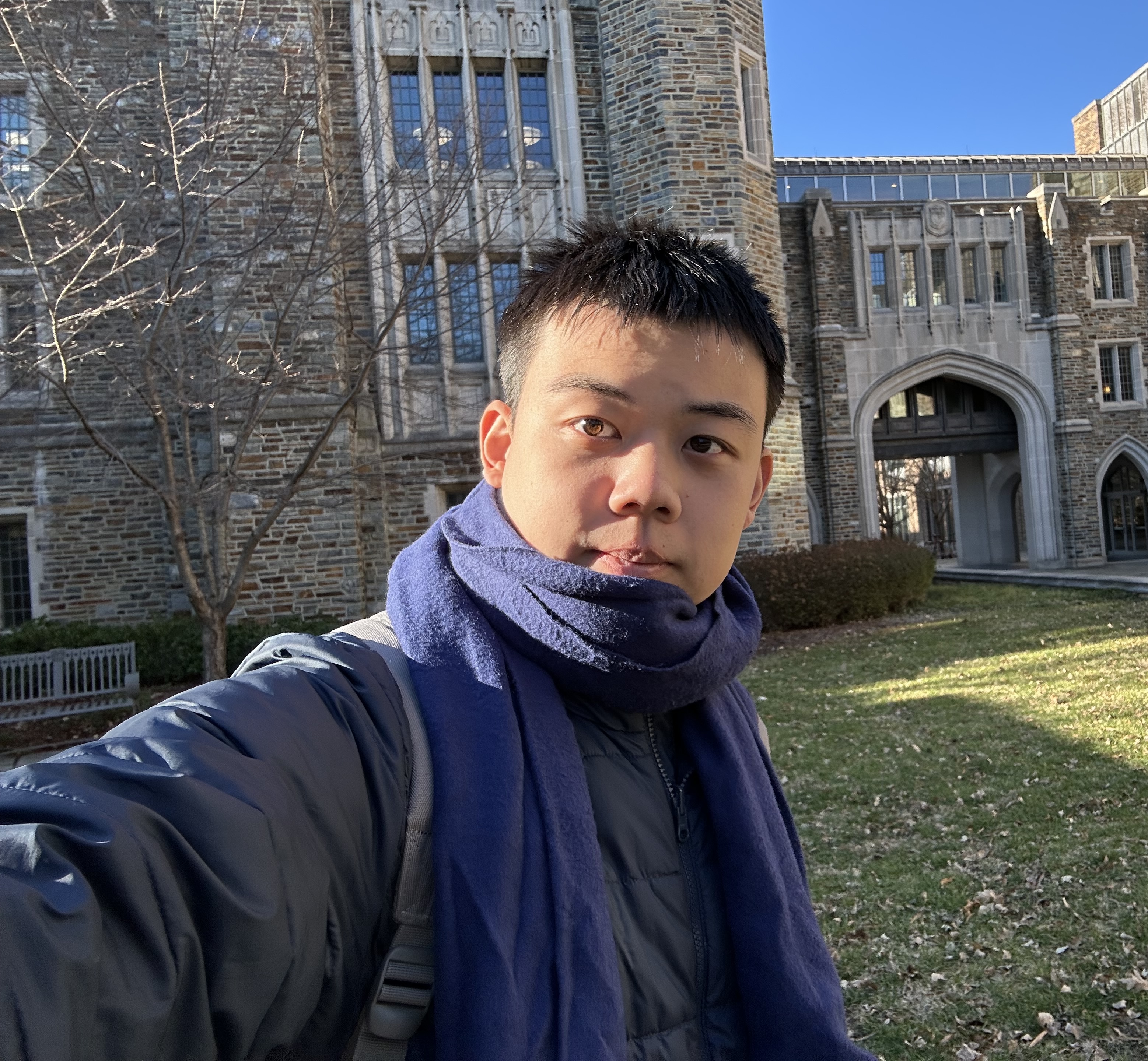
"Grant that I may always desire more than I can accomplish." -- Michelangelo |

|
|
My research focuses on developing efficient and scalable distillation methods for generative models, particularly diffusion and flow-based models. I am interested in extending these techniques beyond image generation to video generation, language modeling, world modeling, and vision-language-action (VLA) models for embodied intelligence and robotics. Some papers are highlighted. |
|
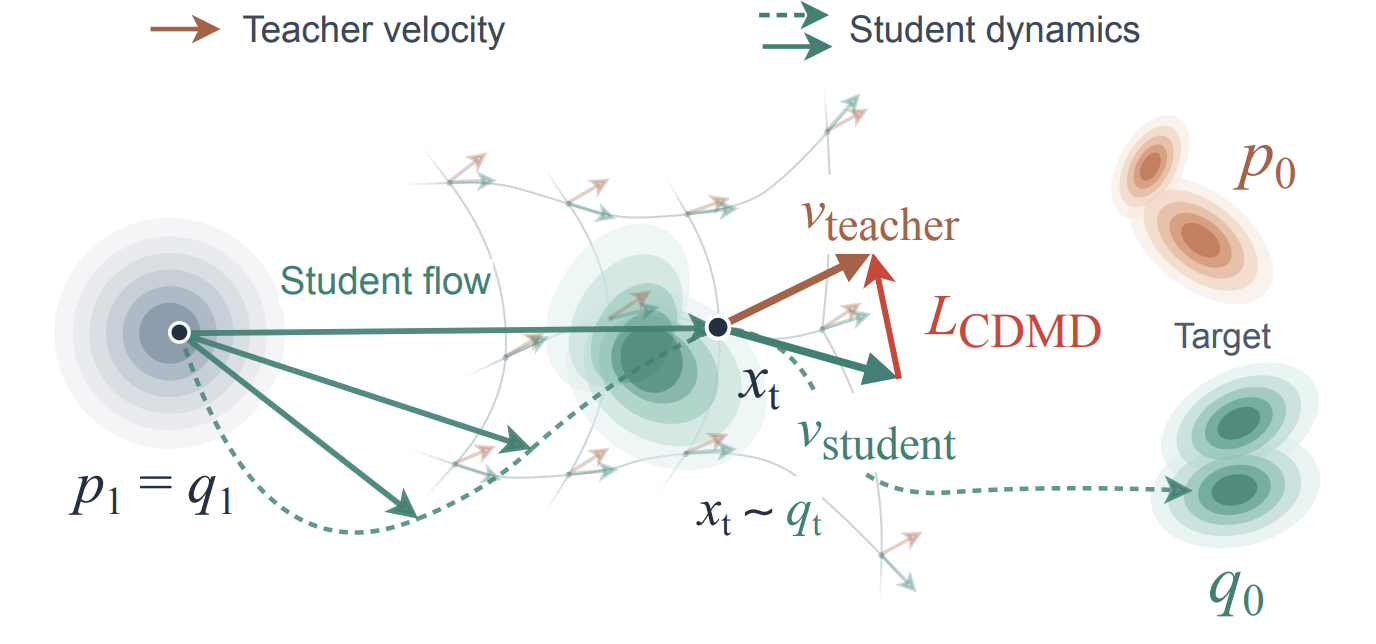
Consistent Distribution Matching for Data-Free Diffusion Distillation
Yuxiang Fu, Qi Yan, Zike Wu, Yongxing Zhang, Purang Abolmaesumi, Lele Wang, Renjie Liao Under review 2026 Project Page / arXiv / Paper / Bibtex We propose Consistent Distribution Matching (CDMD), a data-free and simulation-free distillation method that unifies sample generation and score estimation in one student network, using only a frozen teacher and a trainable student with a single objective. CDMD attains a 1-NFE FID of 2.04 and a 4-NFE FID of 1.37 on ImageNet 256×256. |
|
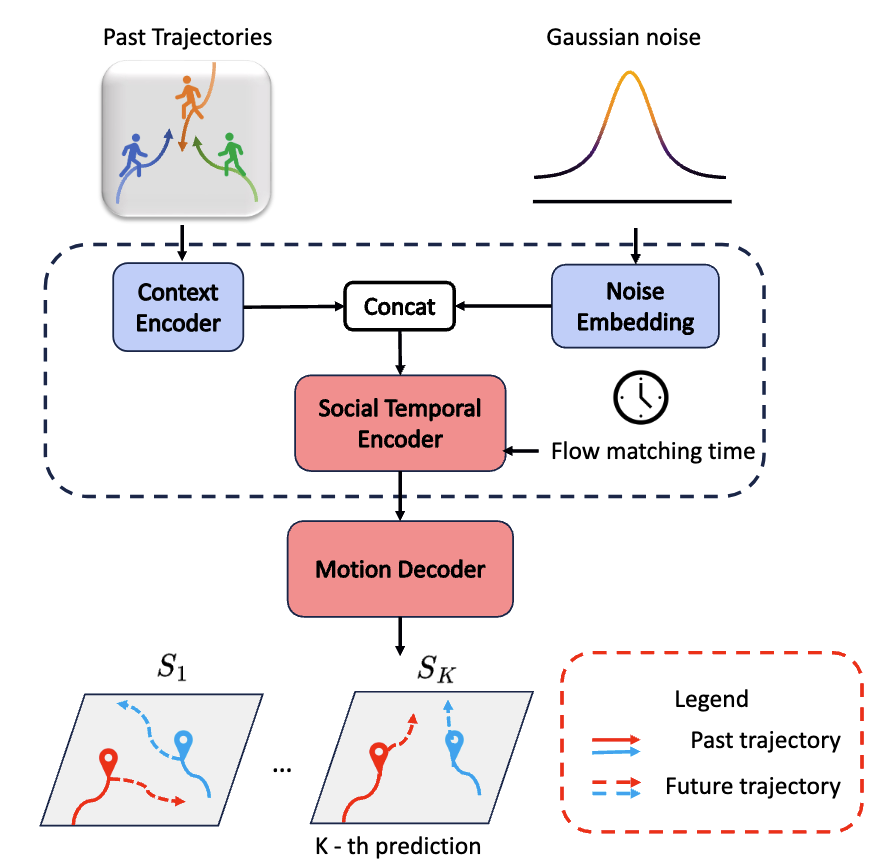
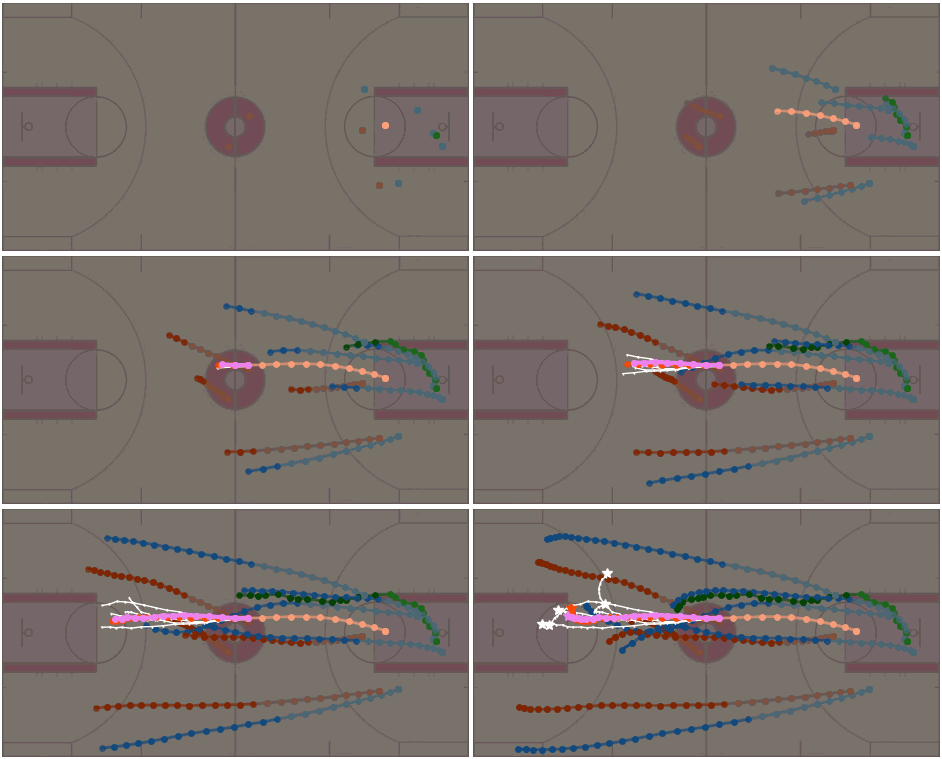
MoFlow: One-Step Flow Matching for Human Trajectory Forecasting via Implicit Maximizing Likelihood Estimation based Distillation
Yuxiang Fu, Qi Yan, Ke Li, Lele Wang, Renjie Liao CVPR 2025 Project Page / arXiv / Paper / Poster / Code / Bibtex We present a novel Motion prediction conditional Flow matching model, termed MoFlow, to generate K-shot future trajectories for all agents in a given scene. In addition, by leveraging the Implicit Maximum Likelihood Estimation (IMLE), we propose a novel distillation method for flow models that only requires samples from the teacher model. |
|
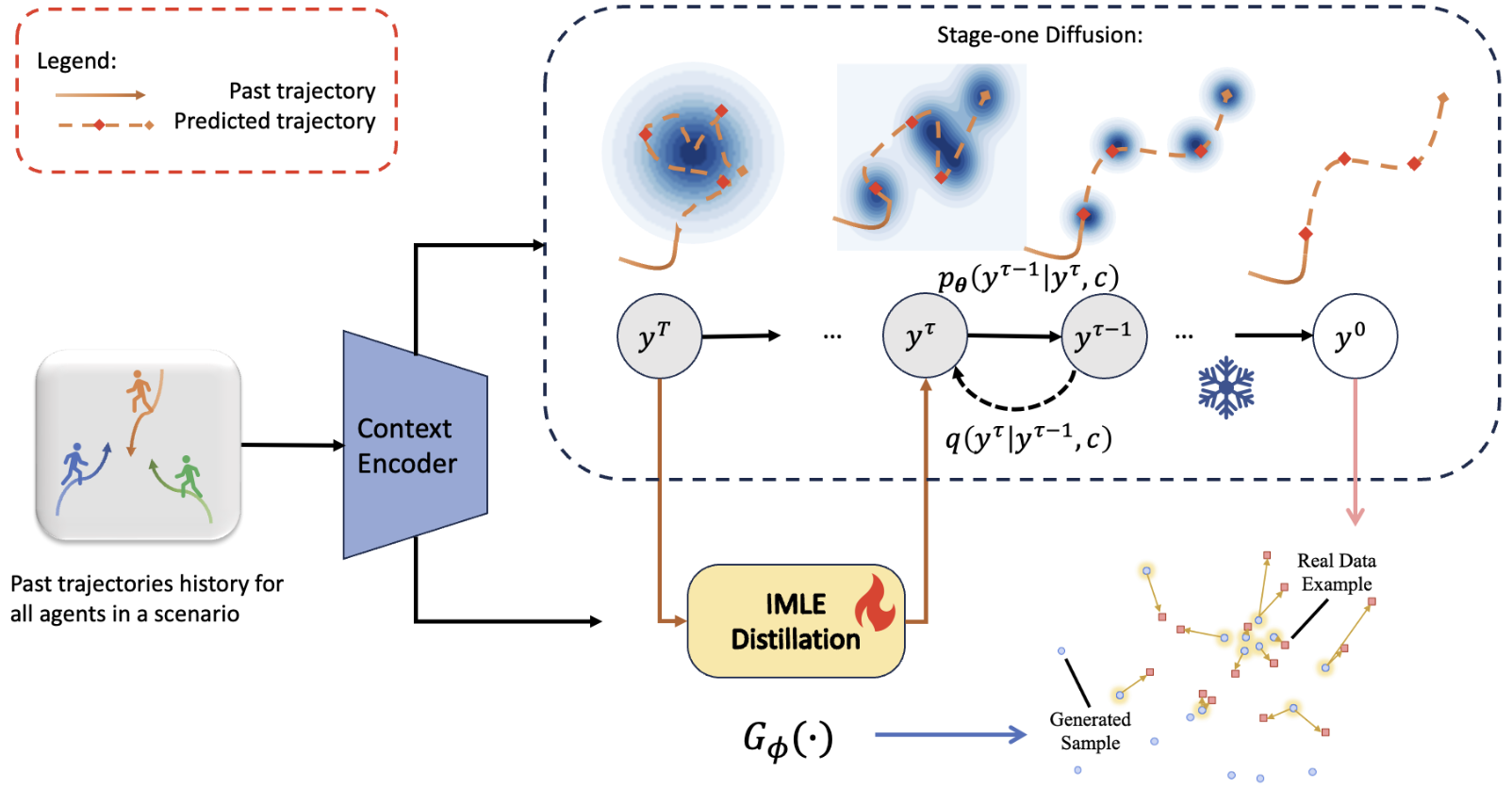
Stochastic Trajectory Generation with Diffusion via IMLE Distillation
Yuxiang Fu, Qi Yan, Ke Li, Lele Wang, Renjie Liao CRV 2024 Workshop, Oral Presentation Slides / Poster We introduce TGD, a diffusion-based human trajectory generation model, along with a trainable student model leveraging the IMLE scheme to align with the teacher diffusion model’s distribution at any intermediate diffusion timestamp. |
|
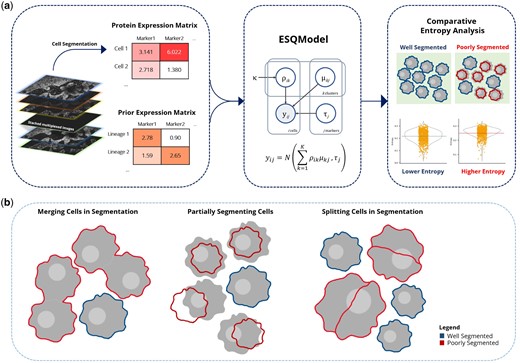
ESQmodel: biologically informed evaluation of 2-D cell segmentation quality in multiplexed tissue images
Eric Lee, Dongkyu Lee, Wayne Fan, Andrew Lytle, Yuxiang Fu, IMAXT Consortium, David W Scott, Christian Steidl, Samuel Aparicio, Andrew Roth Bioinformatics 2024 Journal Article / bioRxiv Accurate single-cell segmentation is essential for spatial omics analysis, yet existing methods rely heavily on expert-driven annotations and separate statistical or biological evaluation strategies, highlighting the need for a unified assessment approach. ESQmodel alleviates this limitation. |
|
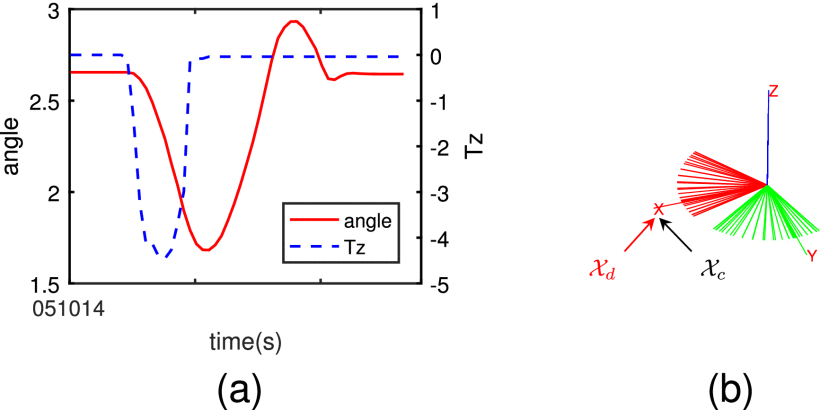
Rotational Impedance Formulation in a Unified Viewpoint of Lie Algebra
Jian Fu, Siyuan Shen, Yuxiang Fu, Kui Xiang IEEE Robotics and Automation Letters 2025 We aim to elucidate the fundamental nature of rotational impedance and presents a comprehensive, unified framework for formulating rotational impedance using Lie algebra and Noether's theorem. In particular, we utilized quaternions and rotation matrices to represent rotational motion within our proposed framework to ensure theoretical validity. |
|
PCVAE: a Controlled deep VAE for Pancancer
gene expressions clustering analysis
Yuxiang Fu Content A slight tweak of the variational autoencoder that controls the primary tissue effect of the bulk RNA sequencing data from PCAWG/ICGC dataset. PCVAE offers the ability to uncover novel connections across heterogeneous cancers in a site-effect-free environment. |

|
Vector Institute for AI
2024.01 - 2024.05 Research Intern |
|
Borealis AI Let's Solve It
2023.09 - 2023.12 Team Leader, BinAry Flow Jedi Research Advisor: Dr. Raquel Aoki News / Project / Slides |

|
Google CSRMP
2023.09 - 2023.12 Program Mentee Program Advisor: Dr. Hyodong Lee |

|
BC Cancer Research Center
2022.05 - 2023.05 Research Intern Research Advisor: Prof. Andrew Roth Mini Conference Poster |

|
Teaching Assistant
2021.01 - Present CPSC 210 x 6, CPSC 330 x 2, CPEN 455 x 3, CPSC 304 x 1 |
|
|
|
This webpage is build based on Jon Barron's website and deployed on Github Pages. Last updated: © 2026 Yuxiang (Felix) Fu |